

Most auto repair shops know their daily car count. Yet fewer know exactly how much profit each month produces. To stay profitable, shop owners must understand where money comes from, where it goes, and what remains at the end of the month. That is where an auto repair shop income statement becomes essential.
An income statement gives you a clear picture of your shop’s financial performance over a specific period. It shows revenue, costs, and profit in a structured way. When used correctly, it helps you make better decisions, control expenses, and plan for growth.
Industry data shows that a typical auto repair shop generates around $750,000–$1.5 million in annual revenue. The net profit margins average roughly 15 – 25 %. This means a shop that isn’t tracking income and costs effectively could be leaving thousands of dollars on the table each year.
Many shop owners avoid financial reports because they seem complex. In reality, once broken down, an income statement is one of the simplest and most useful tools you can use. This guide explains the income statement in plain language. You will learn what it is, how it works, what numbers matter most, and how to use it to run a healthier shop.
What is an Auto Repair Shop Income Statement?
An auto repair shop income statement is a financial report that summarizes how much money your shop earned and spent during a specific period. That period is usually monthly, quarterly, or yearly. The statement follows a simple flow:
- Revenue comes in
- Costs are subtracted
- Profit or loss remains
This report is also known as a profit and loss statement. While the name may differ, the purpose stays the same. It helps shop owners understand whether the business is making money and why. Unlike a balance sheet, which shows what you own and owe, an income statement focuses only on performance. It answers one critical question: Did the shop make a profit during this period?
Why the Income Statement for Auto Repair Shops Matters
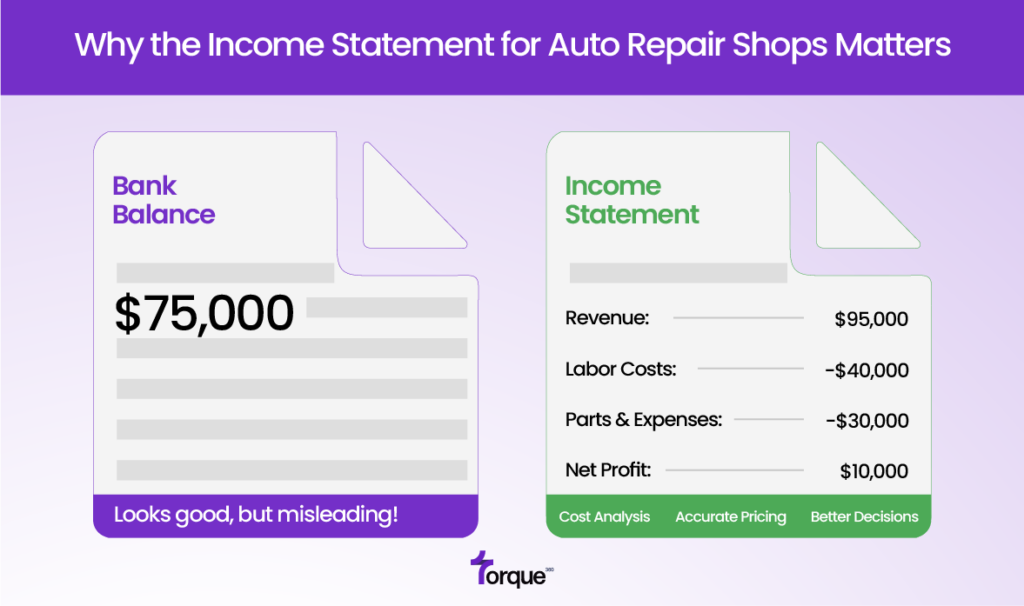
Many auto repair shops rely on bank balances to judge success. That approach can be misleading. A strong bank balance does not always mean the business is profitable. An income statement for auto repair shops shows the full story.
Better decision-making
With a clear income statement, you can see which services perform well and which ones hurt margins. You can also spot rising costs early.
Improved cost control
Tracking expenses regularly helps you control labor costs, parts expenses, and overhead. Small issues become visible before they turn into large problems.
Accurate pricing
If you do not know your true costs, pricing becomes guesswork. Income statements show whether labor rates and parts markups support profitability.
Financial confidence
Understanding financial reports reduces stress. You gain confidence when reviewing performance, planning investments, or speaking with accountants and lenders.
5 Key Components of an Auto Repair Shop Financial Statement
Every auto repair shop financial statement follows a similar structure. The sections below explain each part in detail, using examples relevant to auto repair shops.
1. Revenue
Revenue is the total money your shop earns before expenses. In auto repair businesses, revenue usually comes from two main sources:
- Labor sales
- Parts sales
Labor revenue includes billed technician hours. Parts revenue includes the sale of components used in repairs. Some shops may also include fees, diagnostics, or sublet work. Accurate revenue tracking is critical. Mixing labor and parts can hide margin issues. Separating them gives better insight into performance.
2. Cost of goods sold (COGS)
Cost of goods sold represents the direct costs required to deliver services. In auto repair shops, COGS usually includes:
- Technician wages are tied directly to billable work
- Cost of parts sold
- Sublet repair costs
COGS does not include administrative wages or rent. Those belong in operating expenses. Keeping this separation clean improves reporting accuracy.
3. Gross profit
Gross profit is calculated by subtracting COGS from revenue. This number shows how efficiently your shop delivers services. A healthy gross profit allows your shop to cover operating expenses and still produce net profit. If gross profit is weak, no amount of cost-cutting elsewhere will fix profitability.
4. Operating expenses
Operating expenses include all costs required to run the shop that are not directly tied to specific repair jobs. Common examples include:
- Rent or mortgage
- Utilities
- Insurance
- Office salaries
- Marketing
- Software subscriptions
These expenses should remain stable relative to revenue. Sudden increases may indicate inefficiencies.
5. Net profit
Net profit is the final number on the income statement. It represents what remains after all expenses are subtracted from revenue. A positive net profit means the business is profitable. A negative number signals a loss. Tracking net profit consistently helps shop owners measure long-term success.
Sample Income Statement for Auto Repair Shop
A sample income statement for auto repair shop owners helps bring these concepts together. Below is a simplified example for a single month.
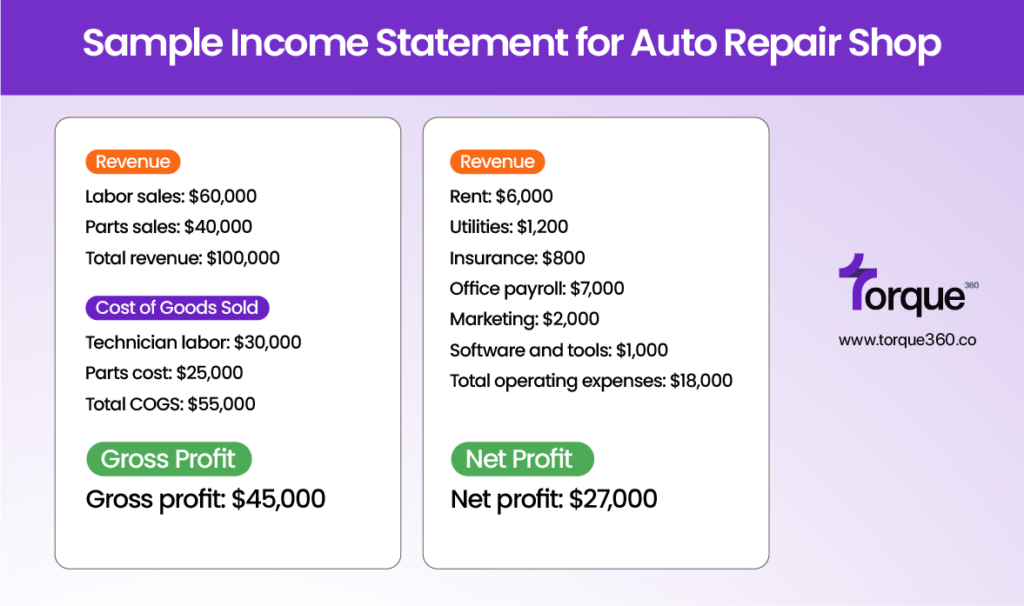
This sample income statement for auto repair shop owners shows how revenue flows through the business. Reviewing a report like this monthly helps identify trends early.
Auto Repair Shop P&L Example Explained
An auto repair shop P&L example follows the same structure as an income statement. The term “P&L” simply emphasizes profit and loss. What matters most is how you interpret the numbers. Focus on relationships between sections, not just totals.
Gross profit margins
Labor and parts margins should be reviewed separately. Many shops lose profit due to low labor efficiency or weak parts markup.
Expense ratios
Compare operating expenses to total revenue. High ratios may indicate overstaffing or excessive overhead.
Net profit consistency
Strong shops show consistent net profit across months. Large swings often signal operational problems.
Reviewing an auto repair shop P&L example monthly builds financial discipline and prevents surprises.
Profit and loss statement for auto repair shop owners
A profit and loss statement for auto repair shop owners should be easy to read and accurate. Complexity reduces usefulness. When reviewing your report, ask simple questions:
- Is revenue growing or shrinking?
- Are labor costs aligned with billed hours?
- Are operating expenses controlled?
The profit and loss statement works best when reviewed regularly. Waiting until year-end reduces its value.
Auto Repair Shop Financial Statement Basics
Understanding auto repair shop accounting basics helps you use income statements more effectively.
Accrual vs cash accounting
Cash accounting records income when money is received. Accrual accounting records income when work is completed. Most professional reports use accrual accounting for accuracy.
Consistent reporting periods
Always compare similar periods. Monthly reports should be reviewed month over month and year over year.
Clean categorization
Misclassified expenses distort reports. Labor should not appear in operating expenses, and office wages should not appear in COGS.
Mastering auto repair shop accounting basics improves clarity and reduces confusion when reviewing reports.
Auto repair shop financial reporting best practices
Strong auto repair shop financial reporting depends on consistency and accuracy.
Review reports monthly
Monthly reviews allow faster corrections. Annual reviews are too late to fix operational issues.
Separate labor and parts
Combining them hides margin problems. Separate tracking improves insight.
Track trends, not just totals
Look for patterns over time. One month rarely tells the full story.
Use reliable systems
Modern shop systems can generate consistent reports automatically. Torque360 helps shops track labor, parts, and financial performance without manual spreadsheets.
Good auto repair shop financial reporting turns raw numbers into actionable insight.
Common Mistakes in Financial Reports for Auto Repair Shops
Many financial reports for auto repair shops contain errors that reduce their usefulness. Avoiding these mistakes improves decision-making.
Ignoring labor efficiency
Labor sales without efficiency tracking lead to misleading revenue numbers.
Overlooking small expenses
Small recurring costs add up over time. Subscription services and tools should be reviewed regularly.
Focusing only on revenue
High revenue does not guarantee profit. Costs matter just as much.
Delayed reporting
Late reports reduce accuracy and usefulness. Timely data supports better decisions.
Avoiding these issues improves the reliability of financial reports for auto repair shops.
Using Income Statements to Improve Shop Performance
Once you understand your auto repair shop income statement, you can use it as a management tool.
Improve pricing decisions
Income statements reveal whether labor rates and markups support profitability.
Control staffing costs
Labor expenses can be adjusted based on revenue trends and efficiency metrics.
Plan investments
New equipment, hiring, or expansion decisions become clearer when backed by financial data.
Turning Your Income Statement into a Practical Tool
An auto repair shop income statement is not just an accounting report. It is a practical tool that helps shop owners understand how their business truly performs. When reviewed consistently, it highlights opportunities, exposes inefficiencies, and supports confident decisions.
By tracking revenue, managing costs, and reviewing financial reports regularly, shop owners gain better control over daily operations. Over time, this discipline leads to stronger margins, improved stability, and more predictable growth.
The goal is clarity, not complexity. A simple and accurate income statement for auto repair shops gives you the insight needed to run a profitable shop and plan for the future with confidence.
Frequently Asked Questions
What’s the difference between an income statement and a profit & loss (P&L) statement for my auto repair shop?
Many auto repair shop owners use the terms interchangeably. However, they mean the same thing. It’s a report that shows how much money the shop earned and spent over a period. It lists revenue from services and parts. It also subtracts costs and expenses and shows net profit or loss. Reviewing this regularly tells you if your pricing, labor charges, and parts margins are covering costs and generating real profit.
Should auto repair shops separate parts and labor on their income statements?
Yes. Splitting parts income from labor income gives a clearer picture of where revenue and profit come from. If you combine them, you can miss margin trends. This is because parts often have lower margins than labor. Separating them also makes it easier to set prices and identify underperforming services. It helps make informed decisions about where to focus sales efforts.
How often should auto repair shop owners review their income statements?
Shop owners should review income statements at least monthly. Monthly reviews help you spot rising costs, margin shifts, and cash flow issues early. It’s much like doing routine maintenance before a bigger problem develops. Seeing patterns over several months gives more insight than a single snapshot at year‑end.