
So your auto shop incurs a monthly cost of $10,000, including rent, utilities, insurance, and salaries for the staff. It also covers parts and labor. Your shop may charge an average of $200 per repair. An auto repair shop usually needs between 100 and 150 repairs per month to break even. But at times, auto shops may struggle financially. Shop owners are looking for financial assistance for auto repair shops to see a significant impact on their business.
Whether it’s about starting an auto repair shop or expanding your current business, an auto repair shop’s financial plan is crucial to becoming successful. The auto repair financial plan covers all operational costs with respect to the future expenses, including tax deductions, loan repayments, equipment maintenance, and so on.
Why Most Auto Repair Shops Struggle with Finances (and How to Fix It)
There comes a time when auto repair shops struggle to pay bills. It could be a slow season, or a lack of a proper financial plan in the first place. But to understand financial assistance for auto repair shops, you need to understand where most shops go wrong.
Common financial mistakes auto shops make
- Underpricing your services: Setting a too-low labor rate makes it hard to stay competitive, and it eats up your profits.
- Ignoring expenses: Not planning for taxes, licensing fees, software subscriptions, and warranty callbacks is one of the common financial mistakes to make.
- No tracking system: If the owner does not have a proper auto repair shop financial statement or accounting software, it’s hard to see where the money is going.
- Limited access to funding: an auto repair shop business is expensive, and you may need a loan for a car repair shop to qualify as a business owner.
- Limited experience: Without the right experience in preparing a financial assistance for auto repair shops, your business can suffer. An auto shop needs industry knowledge and a trained staff to manage the business finances
Real-world example of financial issues in auto shops
National Auto Service Retailer: Wrong pricing strategy
Known as one of the major auto service and tire retailer operating in 350+ locations, discovered issues in their internal pricing. It was inconsistent. Stores in every region were using a different discount rule. Employees even override prices. They also used fragmented data systems, which did not cover the actual cost of parts and labor.
- Financial impact
A weaker pricing model for auto service was a major giveaway. The brake repair jobs should have been at $450, based on labor and OEM parts, but were often discounted to $350 to $375. This way, the company was losing millions of jobs per month.
- How they fixed the pricing strategy
With the help of data analytics, they tracked costs, competitors’ pricing, and customer buying power. A structured pricing improved their profitability across all branches.
However, after adopting a unified pricing strategy and real-time data from analytics, they earned millions more in their operations.
Even an independent repair shop can fall into the pricing trap to keep its customers happy. But without a financial model for auto repair shop pricing, your bays are at greater risk.
Facility Purchase Case: Cost segregation via tax savings
An independent repair shop invested $1million to purchase and renovate a facility. The initial plan was to depreciate the property with a standard 39-year schedule. It meant slow tax deductions. It also meant limited short-term cash flow relief.
- Financial impact
The shop experienced a tight financial year after the expansion. Loan repayments were high, and liquidity for parts inventory was limited. The financial plan for the auto shop was not ideal, as the owner risked running the business on cash.
- How they fixed the cost segregation
Multiple portions of property, such as lighting, HVAC, or flooring, etc, were reclassified into 5, 7, and 15-year depreciation categories. As a result, bonus depreciation under U.S. tax law gave the shop thousands of dollars of tax savings.
2. Reliable Auto Repair: Lead generation shortfall
According to Localogy, an auto repair shop in San Jose with an excellent reputation and regular comebacks experienced a revenue downfall. They delivered quality service, but still weren’t able to attract new customers. Their online visibility was almost zero. No search engine optimization, had minimal meta ads, and Google Business updates were inconsistent.
- Financial impact
Because the shop relied on good word of mouth, it meant limited monthly car counts. Competitors advertised aggressively online. Hence the reason. Reliable Auto Repair lost potential walk-ins because potential customers couldn’t find them on Google.
- How they fixed the leads
Finally, investing in local SEO and paid search campaigns, within months, they were able to rank on keywords like “auto repair near me” searches in the local neighbourhood. Shop was able to generate 740+ calls per month due to improved online visibility. Therefore, digital marketing or paid campaigns should be part of the sustainable auto repair shop’s financial plan.
Creating a Budget for Your Auto Repair Shop Finances
A properly structured financial assistance for auto repair shops ensures that all expenses are covered. Auto repair shop profitability is maintained, and it is prepared for growth. Here’s how shop owners can design a budget for their auto repair shop.
1. Fixed vs variable costs
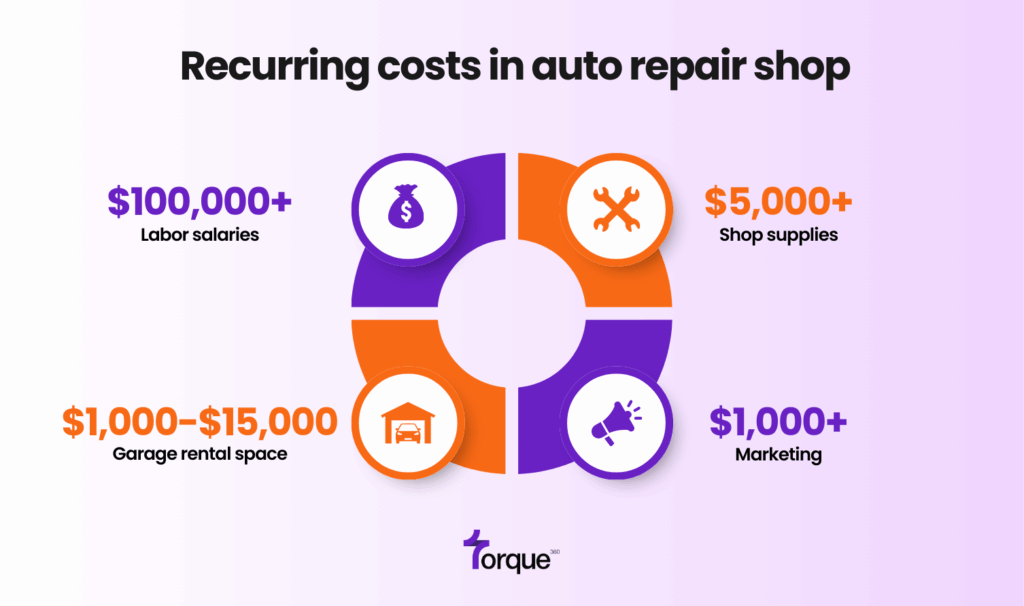
Knowing the differences in the costs helps in shop expense planning; this way, you can monitor changes in the financial assistance for auto repair shops and its profit. There are two types of costs that every auto repair shop incurs:
- Fixed costs: These costs do not fluctuate every month. They form the backbone of the auto repair shop’s financial statement, such as a shop
- Variable costs: Parts, hourly labor, and materials are considered to be variable costs as they depend on the workload. For heavy-duty repairs like transmissions, variable cost will increase, but not for an oil change.
2. How to forecast auto repair shop revenue
To be able to forecast revenue, shop owners must be able to conduct financial analysis for auto shops. They can consider the following factors:
- Seasonality: The demand for car repairs shifts with seasonal change. AC services and cooling system repairs are more common in summer, while battery replacement is a winter concern.
- Service mix: Not all repair jobs will generate the same profits. A steady cash flow can be ensured with routine maintenance, but big tickets like engine rebuilding can increase the repair shop’s profitability if priced correctly.
- Historical data: Using a POS system for reports helps owners to predict the monthly average. For instance, if $200 per repair is an average cost, you will need to complete 120 repairs per month. Therefore, you can create a forecast depending on your business growth goal.
3. Building profit margin into your budget
A common mistake in an auto repair shop’s financial plan is to ignore the profit account. To calculate costs, set the price a bit higher, so the margin will improve.
For instance, your goal is to have a 20% profit margin. Your total expenses (fixed and variable costs) are $50,000. Then you should aim for $62,500 in revenue.
In this approach, you will be covering costs but also planning for the auto repair shop’s profitability through smart financial assistance for auto repair shops.
6 Auto Repair Accounting Tips for a Profitable Year
When planning financial assistance for auto repair shops, remember that cash flow is more important than generating revenue. Shops may have big monthly sales, but if they still struggle to pay rent and supplies, then cash flow is not strong. Therefore, you need to implement auto repair shop cash flow practices that will create long-term sustainability:
1. Managing receivables
A common challenge for mechanics is the delayed payments. More often than not, customers can take weeks to settle their invoices. You can fix this issue by sending reminders immediately after the job ends.
Use of digital invoicing software also ensures that customers can pay with a click.
Request a partial deposit for heavy repair jobs to make sure labor and parts are covered beforehand.
2. Cutting cash leaks (unused parts, overtime labor)
Financial assistance for auto repair shops is considered poor if:
- Parts are misordered or remain unused.
- Labor is working overtime due to ineffective scheduling.
- Overstocking parts without foreseeing the actual demand.
Performing a monthly financial analysis for expenses and inventory will help you identify the leaks in your auto repair shop’s financial plan.
3. Using digital payments & POS to speed up cash cycles
Modern POS systems are meant to be used by auto repair shops. Offering multiple digital payment methods allows the shop to:
- Accept credit/debit cards and mobile wallets right away.
- It also reduces the risk of bounced or late payments.
- Owners can sync the transaction from having QuickBooks integration with their financial statement for more efficient reporting.
4. Daily vs. monthly financial review
Your approach to financial assistance for auto repair shops will depend heavily on the number of times you choose to review it.
Daily review can be done with the shop management software. You can get real-time insights into the estimates, jobs, and invoices, and track the labor hours and productivity levels.
Making adjustments becomes easier, too, to address any issues if they arise.
Whereas monthly reviews offer a more comprehensive view of the shop’s profitability. You can analyze income statements, balance sheets, and cash flow statements as part of the auto repair shop’s financial plan. It’s more helpful in long-term planning.
5. Pay employees twice a month
A common accounting issue in the auto repair industry is related to labor costs. Paying employees every two weeks over a few-month time span means extra paychecks. It can peak the labor cost and drive rushed decisions. Owners looking for financial assistance for auto repair shops can address this concern by running payroll bi-weekly instead.
You can calculate actual hours/days versus labor revenue on the working days to pay your mechanics. This way, mechanics’ jobs and pay are based on the actual hours they work.
6. Track auto repair shop inventory
A common practice is to buy parts on demand. Many auto repair shops maintain an inventory of less than $10,000. It means you must use a shop management system to track the OEM parts in stock. Every part you use in the repair is charged and needs to be tagged in the repair job created. Once a job closes, the cost incurred for the part should be added to the bill.
Following up with this practice allows you to take a closer look at the real-time profit margin on each job. This way, you can make informed decisions.
7 Smart Pricing Strategies for Your Auto Shop Financial Plan
A pricing strategy must reflect the auto shop’s financial plan, labor rates, and cover associated costs. To stay competitive, you can try following these strategies:
1. Cost-plus pricing
It means to add a markup to the total cost. A guaranteed job covers all expenses and generates profit. The pricing model for an auto repair shop is transparent and predictable.
2. Market pricing
It is also known as competitive and value-based pricing. It sets the labor rate and service fees as per what customers are willing to pay in the neighborhood. You also compare competitors’ pricing to avoid overpricing or underpricing your services in the local market.
3. Flat-rate pricing
Standard plans of financial assistance for auto repair shops are usually focused on a fixed price as per the industry standards. To ensure pricing transparency, shops charge their customers the same price for the exact service, regardless of the job hours.
4. Maintenance plans
As part of the financial assistance for auto repair shops, you can offer customers a subscription plan for regular maintenance. When a monthly fee is offered for maintenance service, customers come back and become regulars. Promoting a more preventative effort towards car repairs reduces the need for major repairs.
5. Tiered pricing
Not all services are valued the same. Offering different levels of services means you can offer varying prices. A basic oil change can cost less. But with additional services like inspections and maintenance checks, you can offer additional pricing.
6. Upselling packages
Provide bundles of necessary services at a reduced cost. Give clients a clear explanation of the benefits of each package and let them select the one that best suits their needs.
7. Warranty pricing
Provide an extended warranty for labor or parts at an extra cost. Ethical behavior entails outlining the warranty’s conditions and related expenses.
What Every Auto Repair Shop Owner Should Know About Taxes
When talking about financial assistance for auto repair shops, you cannot ignore taxes; it’s the biggest pain point for any auto repair shop. If mishandled, missing deductions or handling sales tax incorrectly can hurt your business. Here’s what you should know:
Auto repair shop deductible expenses
Do not leave money on the table (an understood rule of the financial assistance for auto repair shops). Sometimes, auto repair shop owners are unaware of the deductible expenses that often go overlooked:
| Tools and equipment | Wrenches, scanners, lifts, shop jacks, etc, are depreciated and deducted under Section 179. |
| Training and certification | Courses taken on EV diagnostics, OEM factory trainings, and renewals are deductible too. |
| Protective gear | Mechanic shirts with shop logos, steel-toe boots, gloves, safety glasses, etc. |
| Subscriptions and software | Shop management software, technical journals or repair data subscriptions qualify under “ordinary and necessary” business expenses. |
Handling sales tax on parts vs labor correctly
Each state has a different tax rate. For instance, 6% of sales tax in Florida applies to personal property and other services. Therefore, it is important to understand the tax rules to avoid audits and fines:
- Parts usually have sales tax, but labor is often exempted in some states. So labor charges need to be mentioned on invoices.
- In case repair includes parts and labor, tax can be calculated differently or not at all.
- Shop owners should be more careful with the markups. If parts cost you $100, and the bill is $150, you owe $150 in sales tax.
- The best thing to do is use a shop software to generate invoices that split parts vs labor and also calculate sales tax correctly.
Why quarterly financial and tax planning is important for shops
Instead of waiting till the end of December, you can follow tax tips for auto repair shops to help you plan for the quarter:
- Estimated tax payments: if you own a small business, are self-employed, or run an LLC/S-Corp, you might owe quarterly taxes for federal and state.
- Review profits each quarter: You need to check whether profits are above or below projections. In case of higher profits, you need to set aside the amount for more taxes.
- Adjust withholding deductions: If you had a slow quarter, some expenses might be deferred, such as slow hiring.
- Cash missed deductions: Maintain quarterly bookkeeping so you include tools, training, and other deductible expenses.
Extra Revenue Streams Auto Shops Can Tap Into Besides Repairs
A smart auto repair shop’s financial plan captures income opportunities. Shops that diversify their revenue streams are considered more stable, have better margins, and experience long-term growth.
Upselling maintenance services
Financial assistance for auto repair shops is not limited to budgeting only. It also means planning and strategizing additional services. The easiest way to boost margins is via auto repair upselling. Customers trust you with their vehicle, which gives you the right window of opportunity to include add-ons in the services, such as:
- Adding wiper blades and cabin filter installation
- Tire rotation, balancing, and replacement per ticket.
- Checking fluids and top-offs to catch issues before the vehicle breaks down.
Seasonal offers
To create extra income, auto shops can depend on seasonal offers. It’s a proven way to nurture the relationship with the customers at different times of the year. For example:
In summer, you can offer air conditioning inspections or cooling system checks. Or even offer a summer bundle, adding up multiple services that are in demand during the season. See the example below.

In winter, you can run promotions for battery replacements and tire swaps.
During rainy seasons, consider offering limited-time promotions for brake checks, wiper replacements, and tire tread inspections.
These types of advertisements help with auto repair shop financial analysis. You can predict a revenue spike and an increase in customer demand.
Fleet contracts
Fleet maintenance contracts add long-term stability for auto repair shops. You can partner with local businesses, delivery companies, and even government fleets all year round. It ensures recurring income with guaranteed cash flow. Shop owners can build a financial model for auto repair shop forecasting. Also, you have the opportunity to upsell maintenance services to fleets.
The Best Financial Tools & Software to Keep Your Auto Repair Shop on Track
Today, modern shops need auto repair financial tools to help streamline operations, provide accurate reporting, and track expenses, parts, and inventory. The right system caters to financial assistance for auto repair shops and operational needs. Here we have mentioned the top software for auto repair shops to be used daily:
Shop management software with reporting
Using an all-in-one shop management software is one of the most effective platforms to schedule jobs and create professional invoices. Torque360 is a great shop management software for auto repair shops with built-in reporting tools. You can use it to book appointments, create estimates, track repair jobs, expenses, and labor utilization, and monitor every ticket.
The best part is that you can also generate an accurate auto repair shop financial statement for tax season. The reporting dashboard is simple and user-friendly. So even if users are non-tech savvy, they can still easily navigate the dashboard.
This is exactly why users like Tatiana, who runs an auto repair shop, find such software easy to use.

Accounting platforms
Accounting software helps maintain your books. Tools like QuickBooks or Xero are ideally used by the majority of garages, auto repair shops, and small businesses because:
- Bank reconciliation and expense tracking are automated
- Mechanic small business taxes, like sales tax, are meticulously handled.
- Cash flow statements are provided in detail.
As we discussed above, tools can be integrated as well with smart shop management software. Smart integrations allow mechanics to focus on one too. For instance, if you are using Torque360, integrating with QuickBooks is not an issue at all.
Payroll & staff tracking tools
Timely payment of your staff is important to ease the nerves of your employees. Labor is a recurring and the biggest cost in any shop. You can use Gusto or ADP for employee scheduling and time tracking. Monitoring overtime in compliance with labor laws is easier too. Also, generating accurate payroll and keeping tax deductions in focus is not an issue for auto repair shops.
Build Long-Term Auto Repair Shop Funding and Loan Options
Daily, several maintenance functions are performed in auto repair shops, including mechanical and electrical repairs, auto body repair, paint, glass repair, and so on. By 2026, the global auto repair market is expected to grow by 10.3%. But even so, the struggle to train mechanics, find parts, customer comebacks, and parts availability on time is yet prominent.
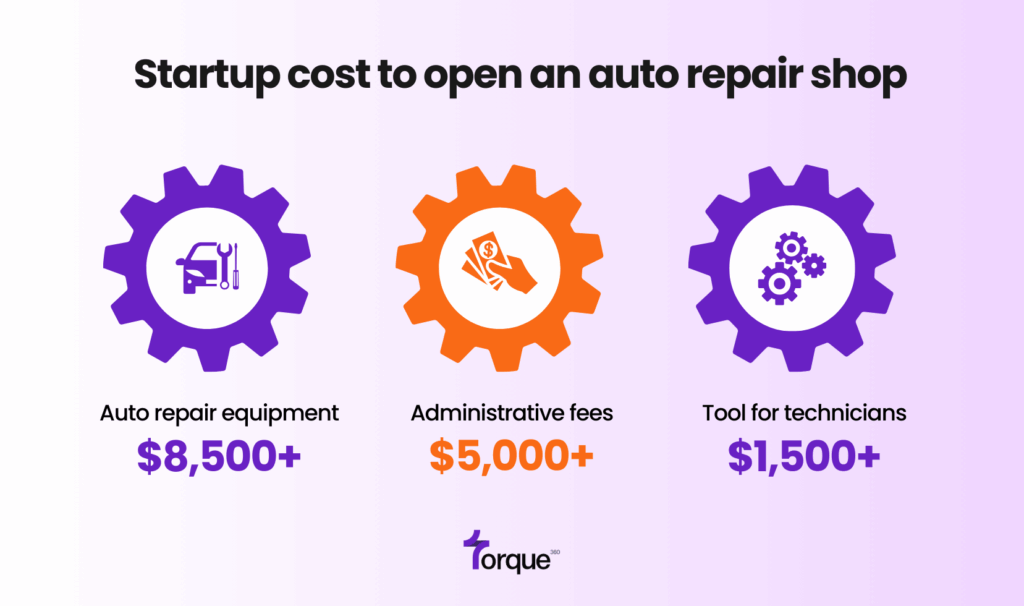
Auto repair loans are one way to bridge the financial gap, so you can invest in the right technology, reduce costs, and improve profit margins. This is why multiple auto repair shop loan options are available to overcome certain challenges.
There are two major categories available: long-term and short-term funding for auto repair shops, including:
1. SBA auto repair shop loan
Also known as the Small Business Administration (SBA), it approves and disburses partnering commercial lenders like banks and credit unions. It’s a low risk for lenders, but it encourages them to grant more loans to auto repair shops. You can get funding up to $5million as 7(a) guaranteed loans —a popular form of auto repair shop business loan.
2. Bank loan for repair shops
Most of the bank loans are term loans repaid over a specific time period. The interest rate is either fixed or variable. However, the bank loan for auto repair shops is not guaranteed because it depends on the size of the loan and your credit history.
You may need to provide collateral. For bank loans, commercial lenders have strict approval requirements, but not as strict as the SBA. However, it still can take weeks or months for bank loans to get approved.
3. Alternative funding
Auto repair shop funding is a practical form of financial assistance for auto repair shops, especially for small businesses with a lesser emphasis on your credit score. Approval requirements are often flexible, but rates can be higher than those of other types of auto repair loans. Owners can often repay daily or weekly, depending on the alternative funding they’ve received.
4. Equipment financing
Designed to finance the purchase of new equipment like vehicle scanners or digital vehicle inspection tools, the lender usually covers 80-100% of the cost. The new equipment itself serves as collateral for this kind of loan.
Steps to Smarter Financial Assistance for Auto Repair Shops
To get your auto shop repair finances in control, focus on the basics first and then build up from there. Here are four easy steps to do so:
Step 1: Review your current numbers
First, take a detailed look at the revenue, expenses, and profit margins. In case you do not have a planned financial assistance for the auto repair shops, you can create one at any time. It will give you a clearer picture of the cash flow and also highlight the areas that require auto repair financial assistance.
Step 2: Create a simple budget
It’s good practice to list down fixed costs like rent or salaries, and the variable costs like parts and labor. A basic plan of financial assistance for auto repair shops will help prevent overspending and best prepare for emergency funds.
Step 3: Adopt 1–2 financial tools
You do not need multiple tools to manage your finances. Shop owners can start with the shop management software that covers reporting, accounting tools, and integrations like QuickBooks. Use of such software provides effective financial assistance for auto repair shops and makes analysis easier with improved accuracy. With the right financial plan for an auto repair shop, you have a better chance of getting your loan applications approved and are well-prepared for tax preparation.
Step 4: Train staff & set monthly reviews
Always train your team to log jobs, especially when using a smart tool like Torque 360. Also, train them to track and monitor parts and to enter data consistently. Scheduling monthly financial reviews ensures healthy cash flow into the business, so you can avoid repeating mistakes.
Torque360’s Role in Financial Assistance for Auto Repair Shops
Managing money is just as important as managing repairs. Torque360 goes beyond being a shop management system as it also acts as a reliable form of financial assistance for auto repair shops. With built-in tools for invoicing, tax deductions, and expense tracking on parts and labor, shop owners can reduce errors and improve financial accuracy.
Torque360 makes financial analysis for auto repair shops simple by helping you:
- Generate accurate invoices in seconds.
- Apply tax calculations and deductions directly within estimates.
- Track parts and labor costs with full transparency.
- Monitor daily jobs, pending bills, and cash flow in real time.
- Stay on top of revenue generation with clear financial reports.
By centralizing auto repair shop finances in one system, owners can cut down on manual paperwork, make smarter business decisions, and stay better prepared for taxes or loan applications.
Frequently Asked Questions
How much should an auto repair shop aim to generate monthly profits?
On average, when planning financial assistance for auto repair shops, you can set a goal to generate between $30,000 – $50,000 per month in revenue to be considered profitable. However, the figure can vary depending on the shop’s fixed and variable costs and the pricing strategy, dependent on the financial plan for the auto repair shop.
How much should an auto repair shop invest in marketing monthly?
According to the financial assistance for auto repair shops, they can invest anywhere between $500 – $1,500 per month on digital campaigns. This money can be spent on meta ads, local promotions, and community events.
How often should an auto repair shop review its financial plan?
A shop can review its pricing strategy and financial model every 6 to 12 months. Regular reviews ensure pricing remains competitive and is in accordance with the marketing conditions. Adjustments can be made according to changes in cost, demand, and industry trends.