The history about auto mechanics has evolved significantly over the past century. Shops went from simple tools in small garages to advanced diagnostic technology. Many aspiring mechanics and shop owners wonder how the industry has evolved. They ask which skills have stood the test of time. They also want to know how technology shapes repair work.
Today, the United States has over 290,000 auto repair shops. What began in small, makeshift garages has grown into a major national industry. Learning the history of auto mechanics shows how repair practices have grown. Modern tools, like shop management software, are now essential.
In this blog, we trace the auto mechanic history & highlight pioneers who shaped the craft. We’ll explore the evolution of mechanic careers. Finally, we’ll examine how technology and modern tools are changing the profession.
History of Auto Mechanics
The history about auto mechanics shows that the first auto mechanics were often self-taught enthusiasts. Some were blacksmiths. Others were inventors who tinkered with early motor vehicles. These pioneers learned by trial and error. They experimented with engines & basic tools in small workshops or even roadside garages. Their ingenuity laid the groundwork for a profession. Over time, it would demand both technical skill and formal training.
Early Garage Practices
- Repairs were improvisational. Mechanics used whatever tools and materials they had. They often devised creative solutions on the spot. These solutions were to fix engines, adjust brakes, or patch tires.
- When replacement parts were scarce, mechanics often crafted components themselves. They honed metalworking and machining skills to keep vehicles running.
- Technical knowledge passed down through apprenticeships or word-of-mouth manuals. Hands-on experience was the main path to mastery, not structured schooling.
4 Famous Auto Mechanics in History
Several notable figures helped shape modern auto repair, including 4 famous pioneers:
- Charles F. Kettering
Charles invented the electric starter in 1912, making cars easier to operate and repair. His work also influenced future mechanical design and repair standards.
- Bertha Benz
In 1888, Bertha completed the first long-distance car trip. This showed vehicle reliability and inspired design improvements.
- Henry Ford’s early mechanics
Henry’s mechanics developed maintenance practices for assembly lines. This helped standardize repair techniques and shaped vocational training for future mechanics.
- Ferdinand Porsche
Mechanics pioneered high-performance vehicle design and engineering in the early 20th century. Their work influenced automotive innovation and repair techniques.
These famous auto mechanics in history solved immediate mechanical problems. They also laid the foundation for formal education & the professionalization of auto mechanics.
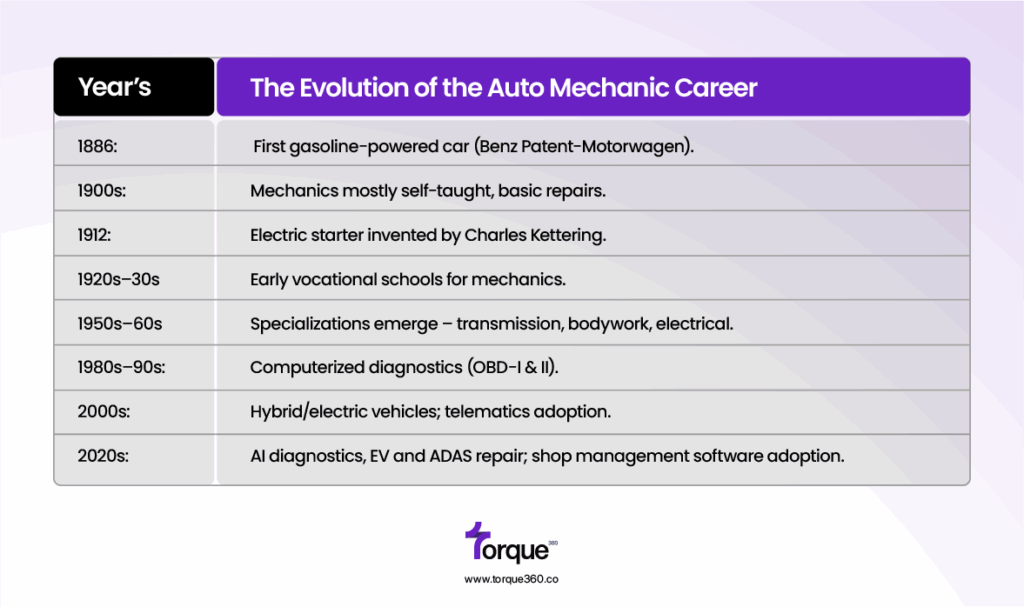
The Evolution of the Auto Mechanic Career
As vehicles became more complex, informal repair work declined. Structured training and certifications took their place. The ASE was founded in 1972. Since then, many U.S. mechanics have pursued formal certification. Today, auto mechanics are highly skilled professionals, blending hands-on experience with technical knowledge.
Auto Mechanic Career History
- Early 1900s
Garage mechanics performed general repairs with minimal formal training. Tools were limited. Much of the work relied on intuition and hands-on problem-solving in small workshops.
- Mid-1900s
The profession became more specialized. Mechanics focused on areas like bodywork, electrical systems, transmissions, and engine tuning. Vocational schools and formal apprenticeships emerged, providing structured training and professional standards.
- Late 20th Century
The introduction of computerized diagnostics, emission regulations, and specialized equipment transformed the trade. Mechanics needed to continuously update their skills to keep pace with evolving technology.
- Modern Era
Mechanics now service hybrid and electric vehicles. They manage advanced driver-assistance systems (ADAS) and perform complex computer diagnostics. Career paths have diversified. Mechanics can become diagnostics specialists, fleet service managers, EV experts, or shop supervisors.
This auto mechanic career history evolution shows the growing demands of the industry. It also underscores the importance of lifelong learning for mechanics.
Technological Advances Transforming Auto Repair
Mechanics today rely on more than just wrenches and screwdrivers. Technology has changed repairs. Work is now faster, more precise, and safer.
| Feature/Task | Traditional Tools | Modern Tools & Tech | Benefits |
| Engine diagnostics | Manual inspection | OBD-II, AI-assisted diagnostics | Faster, more accurate fault detection |
| Brake and suspension checks | Visual and tactile assessment | Digital sensors & software | Preventive maintenance & safety |
| Parts inventory management | Paper logs | Integrated shop software | Reduced errors, improved efficiency |
| Hybrid/Electric repair | Not applicable | Battery analyzers, high-voltage tools | Safe and specialized repairs |
Auto Mechanic History in Tools and Techniques
Automotive technology has transformed how mechanics work. They now use tools from manual inspections to AI-assisted diagnostics. Key developments include:
- OBD-I to OBD-II systems
Mechanics shifted diagnostics from manual inspections to electronic data reading. This change allowed faster and more accurate problem identification.
- Digital diagnostic tools
Modern tools provide real-time monitoring of engine and vehicle performance. This allows mechanics to detect issues proactively.
- Electric and hybrid vehicle repair
Requires specialized knowledge of battery systems, high-voltage safety, and advanced power electronics.
- Telematics and connected vehicles
Mechanics can access vehicle data remotely, supporting predictive maintenance and faster troubleshooting.
- AI-assisted diagnostics
Modern tools leverage historical data and machine learning to suggest repair strategies. This improves efficiency and reduces diagnostic errors.
Mechanics who master both traditional skills and technology are best positioned to succeed. This is the key in today’s automotive industry.
Modern Automotive Technology and Shop Management
Technical skills are still critical. But running a successful repair shop today also requires operational efficiency and organization. Torque360 unifies repair orders, parts inventory, customer communication, and billing in one platform.
- Appointment Scheduling
Easily manage bookings, avoid conflicts, and optimize shop workflow. Ensure technicians and bays are always efficiently used.
- Digital Vehicle Inspections (DVI)
Capture photos and videos during inspections to clearly show customers the condition of their vehicles. This builds trust and makes it easier to explain needed repairs.
- Estimates, Invoices, and Payments
Generate accurate estimates, send professional invoices, and process integrated payments. Reduce errors and save time on billing.
- Repair Order Management
Create, track, and update work orders in real time. Ensure no job is missed, and every repair stays organized from start to finish.
- Inventory & Parts Management
Monitor stock levels, automate reorders, and reduce part shortages. Keep your shop running smoothly without manual checks.
- Customer Management & Reminder Campaigns
Send automated reminders for services and follow-ups. Keep customers engaged and improve retention effortlessly.
- Labor & Employee Management
Track technician hours, monitor job performance, and optimize workforce productivity. Make staffing decisions backed by data.
- Advanced Reporting
Access detailed profitability, labor, and performance reports. Use insights to make smarter operational and business decisions.
- Integrations
Connect Torque360 with accounting software, parts suppliers, and payment systems. Simplify workflows, reduce manual work, and keep all your shop tools in sync for smoother operations.

Shop owners who combine mechanical expertise with technology can focus on quality service. They can also maintain operational control.
Lessons from the Past for Today’s Mechanics
Studying the history of auto mechanics provides insights that are still relevant:
- Adaptability matters
Vehicles and automotive technology continue to evolve rapidly. Mechanics who regularly update their skills stay ahead in the trade. They learn to work on hybrid engines, ADAS systems, and new diagnostics.
- Foundational skills endure
Technology has advanced. But core engine knowledge, troubleshooting skills, and attention to detail remain essential. These timeless skills form the backbone of reliable repairs.
- Technology complements tradition
Modern software and digital tools make repairs faster and more accurate. They do not replace the skill and hands-on knowledge of experienced mechanics.
- Career growth opportunities
Mechanics who embrace technology can specialize in emerging fields. They may work in electric vehicle maintenance, telematics, or fleet analytics. This opens pathways to leadership and higher-responsibility roles in repair shops.
Understanding the history about auto mechanics and balancing between heritage and innovation is key to professional success. Mechanics can leverage Torque360 to combine craftsmanship with operational efficiency.
Honoring Tradition While Driving Innovation in Auto Repair
The history of auto mechanics has evolved from early garages to modern technology. Skills, tools, and professional standards have changed along the way. Mechanics who master old skills and new tech thrive in today’s fast-changing industry. See how Torque360 can modernize your shop. It improves repair tracking, parts management, and customer communication. And it keeps craftsmanship at the forefront.
Frequently Asked Questions
When did auto repair shops first emerge?
Auto repair began in the late 19th & early 20th centuries. It’s the time automobiles replaced horse-drawn carriages. Repairs were simple. Blacksmiths and self-taught enthusiasts did the work in informal garages or sheds.
How did the auto mechanic history evolve?
Mechanics handled basic repairs, engine tweaks, tire/puncture fixes, and simple maintenance. As engines, transmissions, & electrical systems grew complex, auto repair became a professional trade. By the mid‑20th century, specialization emerged (bodywork, transmission, electrical). Over time, auto mechanics became skilled professionals. They manage modern cars, EVs, hybrids, & ADAS using computerized diagnostics & advanced vehicle systems.
What major technological changes transformed auto repair work?
Major shifts include hydraulic lifts. They made undercar work safer and easier. Onboard diagnostic systems (OBD) emerged. Computerized diagnostics and sensors became widespread. Electric and hybrid vehicles required new skills. Telematics-enabled predictive maintenance.
Why did formal training and certification become important for mechanics?
As cars grew more sophisticated, informal knowledge and trial-and-error methods fell behind. Automotive manufacturers began producing service manuals. Vocational schools and trade programs emerged. ASE, founded in 1972, set standards for mechanic qualifications and professionalism.
How does modern shop management software change the auto repair industry?
Modern vehicles are more complex, and repair shops handle many jobs. Tracking repair orders, parts, billing, & customer communication by hand is slow and error-prone. Torque360 integrates all these functions in one system. It improves efficiency, boosts accuracy, and enables data-driven decisions for shops.