
Have you ever wondered why fixing a modern car feels more complex than ever? Or why do some repairs take longer and cost more?
The answer is Advanced Driver Assistance Systems (ADAS). What started as the collection of electronic technologies in cars has now revolutionized vehicle safety. Now, it’s become more of a standard feature in new vehicles, influencing driver safety and vehicle convenience.
However, repair shops are presented with a new challenge in the standard practices. If your shop services cars equipped with ADAS, they might just handle the calibration. In any case, it’s essential to stay competitive and profitable in repair services as demand for ADAS repair services is on the rise.
In this guide, we’ll explain what ADAS means and why proper ADAS service matters. We will also share strategies to help your shop master the ADAS system repair and maintenance.
Advanced Driver Assistance & Why It Matters
ADAS includes electronic features designed to make driving safer and easier. Systems like adaptive cruise control and automatic emergency braking use cameras, radar, and sensors. These devices monitor the vehicle’s surroundings.
According to Revv, by 2025, over 80% of cars sold in the U.S. will include some form of ADAS. This means your shop will increasingly encounter vehicles that require specialized ADAS service and calibration.
Repair shops must approach these systems differently from traditional mechanical repairs. Without proper tools and training, technicians risk compromising ADAS functionality. This can lead to costly callbacks and potential liability issues. For every auto repair business, understanding ADAS system repair has become critical.
Types of ADAS Features
Among the many ADAS, two key features commonly highlighted in modern vehicles are Adaptive Cruise Control (ACC) and Automatic Emergency Braking (AEB). These systems significantly enhance driving safety and convenience by helping maintain speed and distance, and by preventing collisions.
Adaptive Cruise Control (ACC)
ACC automatically adjusts a vehicle’s speed to maintain a safe following distance from the car ahead. Using radar and cameras, ACC detects slower vehicles in the lane and reduces speed accordingly. It then accelerates back to the preset speed when the lane is clear. This feature reduces driver fatigue during long highway drives and improves traffic flow.
For repair shops, proper calibration of ACC sensors is critical after repairs such as:
- Windshield replacement
- Front-end collision repair
- Wheel alignment
Misaligned sensors can cause inaccurate distance readings, leading to unsafe or uncomfortable driving behavior.
Automatic Emergency Braking (AEB)
AEB helps prevent or reduce the severity of collisions by automatically applying the brakes if the system detects an imminent crash. Alternatively, when the driver does not respond in time. It relies on cameras, radar, and sensors to continuously monitor the road ahead for:
- Obstacles
- Pedestrians
- Other vehicles
Any work affecting sensor alignment or system components requires precise recalibration to ensure the system functions reliably. Improper calibration can lead to system failure or false activations, both of which pose serious safety risks.
4 Key Advanced Driver Assistance Systems Components and Functions
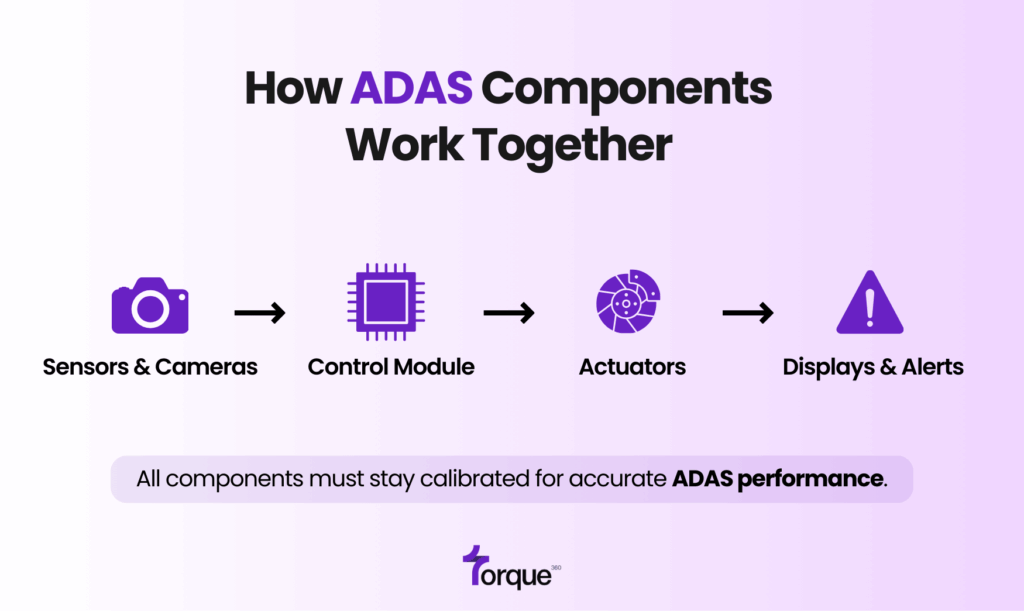
ADAS is a combination of various features that help keep drivers safe while driving. All of the features, such as sensors and cameras, rely on a network of interconnected components. These components work together in real time to keep the vehicle safe and responsive. Here is a breakdown of the core components and their roles in ADAS functionality:
1. Sensors and cameras
Technicians mount these on various parts of the vehicle. Common locations include the front grille, rear bumper, side mirrors, and windshield. They continuously monitor the vehicle’s surroundings. They capture data about nearby vehicles, pedestrians, lane markings, road signs, and other objects. This input forms the backbone of every ADAS feature.
2. Control modules
Also called Electronic Control Units (ECUs), these modules process data collected by the sensors and cameras. They use complex algorithms to analyze conditions in real time and decide how the vehicle should respond. For example, the control module activates the brakes if it detects a potential collision.
3. Actuators
These mechanical or electronic parts carry out the system’s commands. The control module sends an order, such as steering slightly to stay in a lane or applying the brakes. The actuators then respond to carry out the command. They do so instantly and precisely.
4. Displays and alerts
ADAS also informs the driver through dash-mounted screens, warning lights, audible tones, and even steering wheel vibrations. This real-time feedback helps drivers stay aware and understand assistive actions.
Because these components work together, even a minor misalignment or sensor obstruction can disrupt the entire system. Without accurate calibration, the system may fail or provide misleading information. This puts drivers at risk and increases your shop’s liability.
Why Proper ADAS Repair and Calibration Matter
ADAS depends on pinpoint accuracy. Every sensor, camera, radar, and component must align precisely and function fully for the system to operate safely. Many repair scenarios, even minor ones, can knock these systems out of alignment.
Here are the reasons why you must perform proper repair and calibration:
1. Minor errors cause major consequences
Even a sensor misaligned by a few millimeters produces inaccurate readings. This leads to false alerts, missed warnings, or incorrect system responses. These issues weaken the safety features your customers rely on.
2. Improper calibration leads to real-world failures
When technicians skip or perform calibration incorrectly, systems behave unpredictably. Lane departure warnings might not activate, and adaptive cruise control can misjudge distances. Emergency braking may also trigger unnecessarily. These problems create serious safety risks and damage your shop’s credibility.
3. Legal and financial liability falls on shops
In today’s repair environment, improper ADAS repairs or missed calibrations can cause accidents. Your shop faces liability in these cases. Following proper calibration procedures protects both your business and your customers.
4. Accuracy builds customer trust
Your customers count on you to deliver safe, road-ready vehicles. Performing precise ADAS calibration showcases your expertise, strengthens trust, and encourages repeat business.
Accurate calibration is essential for safe, modern repairs. More vehicles now come equipped with ADAS. Your ability to service these systems correctly will determine your shop’s success.
The Rising Demand for ADAS Maintenance and Service
As more vehicles come equipped with ADAS, customer expectations evolve. Today’s drivers expect professional repair shops to service these systems correctly. This includes everything from diagnostics and troubleshooting to recalibration after routine repairs.
Shops that do not offer ADAS maintenance and calibration risk losing customers to competitors who do. This issue goes beyond staying ahead; it is about staying in business.

Insurance companies tighten their requirements as well. After even minor collisions, they often require proof of ADAS recalibration before approving claims. Because of this, shops must find a way to meet these demands. They can either perform ADAS service in-house or partner with trusted calibration specialists.
ADAS maintenance no longer remains a niche service. It now forms a core part of modern vehicle repair. Meeting this demand increases your revenue and positions your shop as a trusted, forward-thinking business.
Essential Tools And Training For ADAS Repair
Successfully servicing ADAS-equipped vehicles requires a strong foundation: the right tools and well-trained technicians. Without both, ADAS repairs can become liabilities instead of revenue sources.
Invest in equipment that ensures every calibration meets manufacturer standards. Cameras, sensors, and radars must align with extreme precision. Even slight deviations can cause system failures or compromise customer safety. To confidently perform ADAS system repairs, your shop needs the following tools:
1. Calibration equipment
These tools allow technicians to precisely recalibrate sensors and cameras after repairs, part replacements, or alignments. Most vehicles require either static or dynamic calibration methods, depending on the manufacturer.
2. Diagnostic scanners
Advanced scan tools play a crucial role in reading ADAS fault codes, performing system resets, and confirming successful calibrations. Generic scanners often miss vehicle-specific data, so Original Equipment Manufacturer (OEM)-level access proves ideal.
3. Alignment machines
Correct wheel alignment forms the foundation of a properly calibrated ADAS system. Modern alignment machines help technicians ensure that the vehicle’s physical positioning matches system expectations, preventing misreadings.
4. Simulation equipment (Software)
Simulation software helps verify ADAS functionality in a controlled, virtual environment. It allows technicians to test system responses to various driving scenarios without needing to take the vehicle on the road. This ensures all components perform correctly after calibration and supports accurate, efficient diagnostics.
Training and Certifications for Your Technicians
Staying current with ADAS technology is essential as these systems evolve rapidly. Your technicians must remain confident and skilled in servicing today’s ADAS-equipped vehicles.
1. Understand different systems across makes and models
Each manufacturer designs Advanced Driver Assistance Systems differently. Your technicians need to recognize how features like lane assist and adaptive cruise control function across various brands. This knowledge speeds up diagnostics and reduces guesswork during repairs.
2. Master proper diagnostics and calibration steps
Accurate diagnostics form the foundation of every ADAS repair. Train your team to use scan tools effectively, interpret fault codes correctly, and identify when calibration is necessary. This approach minimizes errors and ensures vehicles meet OEM safety standards after repairs.
3. Follow OEM calibration procedures
Calibration varies by vehicle. Some require static calibration, others need dynamic road testing, or both. Technicians must strictly follow OEM guidelines, using the right equipment and environment to achieve reliable results.
4. Commit to continuous education
One-time training is not enough. Regular updates keep your team sharp and aligned with the latest ADAS advancements. Encourage participation in online courses, OEM certifications, and hands-on workshops. These activities support long-term technician development and improve repair quality.
Workflow and Process for ADAS Service in Your Shop
Adding ADAS auto service to your repair shop isn’t just a technical upgrade. It’s a business decision. How you choose to integrate ADAS repairs will depend on your budget, staffing, and long-term goals. There are two main approaches, each with unique benefits and trade-offs.
Option 1: Build in-house ADAS capabilities
Offering ADAS service in-house puts your shop in control of the entire repair process. This approach increases profit margins, improves turnaround time, and builds your reputation as a full-service repair facility.
1. Invest in calibration and diagnostic equipment
Start by purchasing OEM-compliant calibration tools and advanced diagnostic scanners. These tools are essential for performing accurate ADAS repairs across various vehicle makes and models. A dedicated space for static calibrations may also be required, depending on your service volume.
2. Train your technicians for long-term success
Your team will need detailed, hands-on training to work with ADAS-equipped vehicles. Focus on understanding calibration workflows, system limitations, and manufacturer-specific procedures. Ongoing education ensures your technicians stay current as ADAS technology evolves.
3. Standardize your repair process
Develop written procedures for every type of ADAS service your shop provides. A consistent process covers everything from initial diagnostics to post-repair calibration verification. This approach reduces errors, protects your shop from liability, and ensures every vehicle leaves safely calibrated.
Option 2: Partner with ADAS calibration specialists
If your shop isn’t ready for in-house ADAS service, outsourcing is a smart alternative. It allows you to offer ADAS support without the upfront cost of tools, training, or facility upgrades.
1. Build partnerships with trusted specialists
Start by identifying experienced ADAS calibration providers in your area. These partners should follow OEM procedures, use certified equipment, and provide documentation for every calibration they perform. Reliable partnerships ensure the quality of service your customers expect.
2. Refer ADAS work while retaining the customer
Instead of turning customers away, refer ADAS-related repairs to your specialist while continuing to handle the rest. This keeps business flowing through your shop and maintains customer relationships. Clear communication with both the customer and the specialist is key to a seamless experience.
3. Focus on your core repair strengths
Outsourcing lets you concentrate on what your shop does best, whether that’s mechanical repairs, diagnostics, or bodywork. By leveraging a partner’s ADAS expertise, you can offer more complete service without overextending your resources.
Take Control Of The Future With an ADAS Service
ADAS-equipped vehicles continue to become more common. Your shop’s ability to provide reliable, professional Advanced Driver Assistance Systems repair and maintenance will determine your success.
While challenges persist, it also enables your technicians to learn a new skillset so that they can differentiate themselves in offering services. Shop owners can embrace the new technological revolution and invest in powerful, specialized tools to adjust their work processes.
It’s easier to stay ahead of the competition by equipping your shop with tools, training, and software such as Torque360. This combination allows you to deliver high-quality ADAS service that builds customer trust and grows your business.
Are you ready to upgrade your shop’s capabilities? Book a demo with Torque360 today and discover how our software simplifies complex ADAS repairs.
Frequently Asked Questions
What is an ADAS system?
ADAS (Advanced Driver Assistance Systems) are electronic features designed to make driving safer and easier. They use cameras, radar, and sensors to monitor the vehicle’s environment and assist with driving tasks.
What are the two main types of advanced driver assistance systems?
ADAS highlights features like adaptive cruise control and automatic emergency braking. These are common ADAS functions that focus on maintaining speed and distance, as well as preventing collisions.
What are the basics of ADAS?
ADAS consists of interconnected components working together in real time. Sensors and cameras capture data about the surroundings. Control modules process this data and decide how the vehicle should respond. Actuators carry out those decisions and display an alert to the driver. Proper calibration ensures the system works accurately and safely.