
Key Takeaways
- Digital vehicle inspections (DVIs) replace paper checklists with photo and video evidence. The customers can see issues on their phone before they say yes or no.
- Shops using DVI software report meaningful gains in approval rates. Industry training data shows DVI boosts customer approval by at least 20-30%.
- Photo-based vehicle inspection removes customer doubt by showing the problem. It’s not just describing it.
- Shops using photo-based DVI report fewer “I’ll think about it” responses. More same-day approvals when customers see the evidence rather than trusting a verbal description.
- You don’t need a big shop to run DVI software. Mobile mechanics and single-bay shops use it effectively.
A digital vehicle inspection (DVI) is a structured, photo-and video-based inspection process. It is completed on a tablet during a vehicle’s service appointment. Instead of handing the customer a paper checklist with handwritten notes, the technician captures photos and videos of each inspection point. Be it worn brake pads, cracked belts, or low fluid levels, the shop sends those directly to the customer’s phone or email in real time.
The customer sees exactly what the tech sees. No “Trust me, it needs it.” Just documented visual evidence delivered while they wait or go about their day. DVI software integrates directly into the shop’s repair order (RO) system. It keeps the entire workflow, inspection, estimate, and invoice in one place.
Why Customers Decline Repairs (And What That Costs You)
Before getting into how digital vehicle inspection increases approvals, understand why customers say no in the first place. The top reasons customers decline recommended repairs are not price but trust in the mechanic. Customers who understand why a repair is needed approve it at far higher rates. Those who receive only a verbal recommendation from a service writer often decline.
Here’s what’s actually happening when a customer says “I’ll think about it”:
- They don’t believe the repair is necessary right now
- They’re not sure the shop isn’t padding the estimate
- They can’t see or feel the problem themselves
- They want to get a second opinion before committing
Each of those objections is rooted in the same thing. The customer doesn’t trust that the recommendation is honest. A photo of the worn rotor removes the suspicion that the problem was invented. That shift from doubt to confirmation is what moves a customer from ‘I’ll think about it’ to a same-day yes.”
The most common RO value range reported by independent shops is $500-$749. This is according to PartsTech’s 2025 State of General Auto Repair Shops survey of 752 shop owners. For a shop doing 80 ROs per week, even recovering one or two additional declined items per day, at any ticket value. It represents thousands in monthly revenue that was already identified and not converted.
How Digital Vehicle Inspection Increases Approvals
Digital vehicle inspection increases approvals through three core mechanisms:
- Visual proof
- Speed of delivery
- Customer empowerment
1. Visual proof replaces verbal persuasion
A service writer saying “your rear brakes are at 2mm” means almost nothing to most customers. A photo of worn-down brake pads, next to a healthy one, communicates the information instantly. It doesn’t require any automotive knowledge from the customer.
2. Speed of delivery keeps customers in the decision window
Traditional inspection results often reach the customer after a phone tag cycle that stretches 30-90 minutes. By then, the customer is distracted, at work, or emotionally disconnected from the car sitting in your bay. DVI software pushes inspection results to the customer’s phone within minutes of the tech completing the walk-around. The customer is still thinking about their car. Follow-ups made within the first 15-20 minutes of sending the report see the highest response rates.
3. Customer empowerment removes the pressure dynamic
When a customer receives a photo report, they can review it at their own pace. They can watch a video of the tech demonstrating the problem, and the decision becomes theirs, not a sales moment.
The Role of Photo-Based Vehicle Inspection in Building Trust
Photo-based vehicle inspection is the single most impactful upgrade a shop can make to its estimate-to-approval workflow. A verbal recommendation forces the customer to process abstract information. It results in a decision with no reference point. A number without context doesn’t move people.
A photo of that same issue removes the translation step entirely. The customer isn’t deciding whether to trust the tech’s judgment anymore. They’re looking at evidence and deciding whether to act on what they can see with their own eyes. That’s a different cognitive task, and it produces a different result.
There are 3 types of photos that drive the highest approval rates in DVI workflows:
1. Comparison shots
A photo of the customer’s worn part alongside what a healthy version looks like creates an instant reference point. Comparison shots drive the fastest customer response. Seeing the contrast between a worn part and a healthy one removes the need for the customer to trust a verbal description.
2. Measurement documentation
Tire tread depth readers and battery test printouts captured in a photo remove all ambiguity from a recommendation. You’re not estimating; you’re documenting.
3. Video walkthroughs
Short 15-30 second videos of a tech demonstrating the problem convert at significantly higher rates. Still photos alone for mechanical concerns require motion to understand.
Photo-based vehicle inspection also creates a liability record for the shop. If a customer comes back two months later claiming you missed something, the timestamped DVI photos show exactly what the vehicle’s condition was at check-in.
How to Win More Repair Approvals With DVI
Winning more repair approvals with DVI is not just about having the software. It’s about building a consistent process that your service writers and technicians follow on every vehicle, every time.
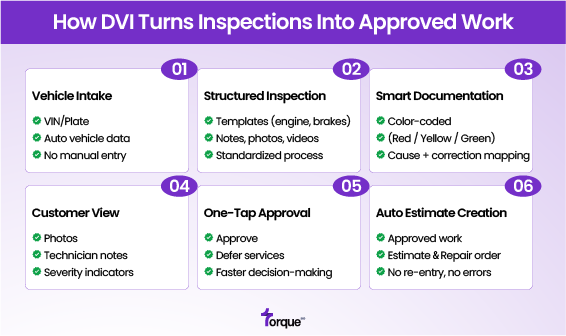
Here is the inspection-to-approval workflow that high-performing shops use:
1. Set the expectation at check-in.
When the customer drops off the vehicle, the service writer tells them, “Our tech will do a complimentary inspection of your vehicle. You’ll get a photo report on your phone before we start any work.” This primes the customer to expect and look for the inspection report.
2. Tech completes the DVI during the first 20 minutes.
The DVI is completed before any repair work begins, not after. Techs who complete inspections post-repair see significantly lower approval rates. The customer’s attention and urgency are already gone.
3. Send the report immediately.
The moment the tech marks the inspection complete, the DVI report goes to the customer via SMS or email. Do not wait for the service writer to review and manually send. Speed matters.
4. Follow up within 10 minutes.
A service writer calls or texts within 10 minutes of sending the report. The script is simple: Did you get a chance to look at the photos we sent? Do you have any questions about what the tech found? This single follow-up step is where most additional approvals happen.
5. Prioritize items by urgency in the report.
DVI software for auto repair shops allows shops to flag inspection items as
- Immediate Action Required (red)
- Needs Attention (yellow)
- Checked and OK (green)
Customers naturally approve of red items at much higher rates. Present red items first, from most urgent to least.
DVI Software for Auto Repair Shops: What to Look For
Not all DVI software for auto repair shops is built the same way. Shops evaluating options should verify the following before committing:
1. RO integration
DVI findings should flow directly into the estimate and repair order with a single click. If the service writer has to re-enter parts and labor after an inspection, that’s double entry. Double-entry creates errors and lost time.
2. Customer-facing report quality
The report the customer receives is a marketing document as much as a technical one. It should be clean, mobile-friendly, and easy to navigate on a phone screen. If it looks like a spreadsheet export, customers won’t engage with it.
3. Photo and video capture from the tech’s device
The tech should be able to take photos and short videos directly from the tablet or phone running the DVI app. Third-party photo transfer workflows slow the process and reduce compliance.
4. Multi-point inspection templates
The software should support customizable inspection templates by vehicle type. So techs aren’t working through irrelevant inspection points on every RO.
5. Digital approval with timestamps
Customers should be able to approve or decline specific line items in the report link. Their response should be timestamped. This creates a documented authorization record for every repair.
6. QuickBooks and accounting integration
Approved items should convert to invoices that sync with the shop’s accounting system without manual re-entry.
Torque360 includes DVI as a core feature within its repair order workflow. It covers photo capture, report delivery, customer approval, and invoice conversion, all from one platform.
Benefits of Digital Inspection Reports Beyond Approvals
The benefits of digital inspection reports extend well past the immediate approval conversation. Shops that have run DVI for 12 or more months report advantages in four additional areas:
1. Customer retention
Customers who receive a DVI on every visit develop a habit of expecting it. When they go to a shop that doesn’t offer it, the experience feels incomplete. DVI creates a loyalty mechanism. It is difficult for competitors to replicate without changing their entire workflow.
2. Google review generation
Shops using DVI report higher rates of unsolicited positive reviews. They mention transparency and being shown photos of the vehicle. Review volume and sentiment both improve when customers feel informed.
3. Technician accountability and performance tracking
DVI software tracks inspection completion rates by technician. Shops can identify which techs consistently skip inspection steps. They can also identify what helps with training and performance reviews.
4. Reduced warranty and comeback claims
When every inspection is photo-documented at check-in, shops have a clear record of the vehicle’s pre-repair condition. This reduces disputes about damage causation and cuts comeback-related labor hours.
How to Increase Car Repair Sales With Inspections
Increasing car repair sales with inspections is a long-term strategy. The shops are seeing the highest revenue impact from DVI inspection compliance as a KPI. It is tracked weekly alongside RO count.
Here are the metrics high-performing shops monitor:
| Metric | Target Benchmark |
| DVI completion rate (% of ROs with a completed inspection) | 90%+ |
| Inspection-to-estimate conversion rate | 80%+ |
| Estimate-to-approval rate on yellow/safety items | 55%+ |
| Average additional items identified per vehicle | 1.5-3.0 |
| Time from inspection complete to report sent | Under 3 minutes |
If your DVI completion rate is below 80%, the delay is in the process, not the software. Shops that tie technician bonuses to DVI completion rates typically see compliance improve significantly within the first 30-60 days. They often reach and sustain the 90%+ threshold.
If your inspection-to-approval rate is low despite high DVI completion, the report quality or follow-up process needs work. Pull 10 recent reports and review them as a customer would. Are the photos clear? Is the urgency obvious? Is the report easy to read on a phone?
Increasing car repair sales with inspections also means connecting DVI to your marketing strategy. Sharing before-and-after photos (with customer permission) on Google Business Profile and Facebook consistently drives engagement. New customer inquiries, because it shows real work rather than stock photography.
Conclusion
Digital vehicle inspection is the most direct lever for most auto repair shops. They can use it for increasing approval rates without advertising spend. The work is already being found. The inspections are already happening. The gap is in how that information reaches the customer and whether they believe it.
Photo-based vehicle inspection closes that gap by turning a technician’s expertise into visual evidence. The customer can see, share, and act on from their phone. Is your shop still delivering inspection results verbally or via a paper checklist? Most shops report measurable changes in approval rates within the first one to two months of consistent DVI use.
FAQ
How does digital vehicle inspection increase approvals compared to paper inspections?
Digital vehicle inspection increases approvals because it sends photo and video evidence directly to the customer’s phone before they make a decision. Paper inspections rely on verbal translation. The service writer describes what the tech found. DVI ends that translation step. It puts the customer in direct visual contact with the condition of their vehicle.
What is photo-based vehicle inspection, and how does it work?
Photo-based vehicle inspection is the process of photographing each inspection point. Those photos are organized into a branded customer report. It is then sent via SMS or email and includes color-coded urgency ratings. The customer reviews the report on their own device and can approve or decline items digitally, often without a phone call.
Can small auto repair shops use DVI software?
Yes. DVI software for auto repair shops works at any scale. From single-bay independent shops to mobile mechanics, everyone can use it. The process grows to the shop’s RO volume. A one-tech shop running 30 ROs per week benefits from DVI just as much as a 10-bay operation. The core problem, customer distrust of verbal recommendations, exists regardless of shop size.
How long does a digital vehicle inspection take for a technician?
A standard multi-point digital vehicle inspection takes 15-25 minutes for a trained technician. Most shops fold this into the first phase of every service appointment. They complete the inspection while the vehicle is on the lift for an oil change or tire rotation. The time investment is recovered within the same RO through additional approved items.
Does DVI software integrate with QuickBooks?
Most modern DVI software for auto repair shops, including Torque360, integrates with QuickBooks Online. Approved inspection items convert to estimate line items. The completed invoices sync to QuickBooks automatically. It prevents double entry between the shop management system and the accounting tool.
What types of repairs see the highest approval rates with DVI?
Safety-related repairs, brakes, tires, steering, and suspension components see the highest approval rates. It mostly happens when presented with photo documentation. Customers are most motivated to act on repairs they understand as safety risks. Photos of worn brake pads or low tread depth communicate urgency. It is better than any verbal description.
Is customer approval via DVI legally binding?
A timestamped digital approval through DVI software creates a documented authorization record. While practices vary by state, most shop operators treat digital approval as a signed repair order. Shops should confirm their specific state’s requirements with their legal counsel. They can also consult an industry association (ASA is a good starting point). Photo-based vehicle inspection also creates a timestamped documentation trail. The shop’s record of exactly what the vehicle’s condition was at check-in.
How do I get my technicians to complete DVIs consistently?
The most effective method is tying DVI completion to a performance review metric. It should be tracked weekly. Set a minimum completion threshold, typically 85-90% of all ROs, and review it in every team meeting. Shops that present DVI compliance data transparently see technician buy-in increase within 30-60 days. Technicians who understand that DVI increases their bay’s revenue complete inspections at much higher rates.