
Most auto repair shops don’t struggle with earning revenue. They struggle with proving it accurately, consistently, and on time.
During the year, everything moves fast. Jobs are completed, parts are billed, and payments are collected across different methods. On the surface, the business runs smoothly. Then tax season arrives.
Your accountant asks for financial reports. The numbers don’t fully align. Revenue looks right in one system but slightly off in another. Expenses are recorded, but not always categorized the same way. A simple filing process becomes a cycle of review, corrections, and reconciliation.
This is where auto shop tax simplification becomes more than a convenience. It becomes a structural advantage.
Shops that rely on disconnected systems treat tax season as a cleanup phase. With integrated accounting reports and real-time sync, tax time becomes a confirmation step. That difference comes down to one thing: how your financial data is managed before tax season.
Why Tax Time Breaks Down in Well-Run Shops
Tax issues rarely come from a lack of effort. This is reflected in industry-wide patterns. Small businesses spend 24–40 hours annually just on federal tax compliance. Much of it is driven by reconciliation rather than actual reporting. They come from a lack of alignment between operations and accounting.
Every job in your shop generates multiple financial entries. A single repair order includes revenue, parts cost, labor allocation, and applicable tax. If these elements are not captured together, your financial picture becomes fragmented.
Over time, 3 specific issues start to surface:
- Financial data is created in one place but finalized in another. This fragmentation is widespread. 94% of U.S. knowledge workers still spend part of their day on repetitive tasks like data entry and moving information between systems. Your shop management system records job activity. Your accounting system becomes the “official” source later. That gap creates inconsistencies in your auto repair financial reports.
- Manual intervention increases as the business grows. More transactions mean more chances for delayed entry, incorrect categorization, or missed updates. As transaction volume grows, this burden compounds. Over 40% of workers spend at least a quarter of their workweek on repetitive data entry tasks. This directly affects tax time efficiency because every report requires validation.
- Reporting becomes reactive. Instead of relying on continuously updated data, you depend on end-of-period corrections. That shifts tax preparation from a review process to a reconstruction process.
What Integrated Accounting Reports Actually Fix
Integrated systems solve this at the point of data creation, not during review. Instead of separating operations from accounting, they connect them.
When a repair order moves through your workflow, financial data is captured:
- The moment an invoice is generated, revenue is recorded
- When parts are added, the cost of goods is linked to the same job
- Labor values are reflected within the transaction
- Taxes are calculated per invoice, not estimated later
This produces integrated accounting reports that are structurally accurate from the start. What makes this powerful is not automation but timing. Your reports are no longer built after the fact. They are built as the work happens. This enables integrated tax reports to remain consistent without heavy year-end adjustments.
What Actually Changes in Tax Preparation
To understand the impact, it helps to compare both scenarios clearly.
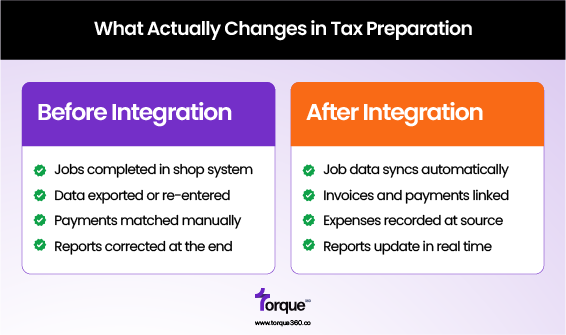
Before integration
In a disconnected setup, your workflow typically looks like this:
- Jobs are completed in the shop software
- Financial data is exported or re-entered into accounting
- Payments are matched manually
- Reports are generated and then corrected
This is why tax preparation becomes reactive. Finance teams already spend around 70% of their time on data collection and reconciliation instead of analysis.
At tax time, you spend hours:
- Reconciling mismatched numbers
- Tracking missing transactions
- Verifying expense categories
After integration
With proper accounting sync for auto shops, the workflow shifts:
- Job activity automatically updates financial records
- Invoices and payments stay linked in real time
- Expenses are recorded at the source
- Reports reflect current data without rework
At tax time, the process becomes:
Review → validate → file
This is the operational reality of auto shop tax simplification. It is not about reducing responsibility but removing unnecessary steps.
How Accounting Sync Works in Practical Terms
Accounting sync is often misunderstood as a simple connection. In practice, it creates a structured data flow between shop operations and accounting.
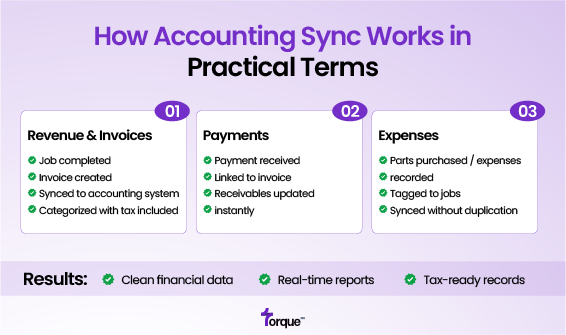
When implemented correctly, three types of data move automatically:
1. Revenue and invoices
Every completed job generates an invoice. With sync in place, that invoice:
- Appears in your accounting system
- Is categorized correctly
- Reflects accurate totals, including tax
2. Payments and receivables
When a customer pays:
- The payment is linked to the original invoice
- Outstanding balances update instantly
- No manual matching is required
3. Expenses and parts costs
Parts purchases and operational expenses:
- Are recorded when they occur
- Can be tied back to specific jobs
- Flow into financial reports without duplication
This is where accounting integration software becomes critical. It ensures that your financial data is transferred and structured consistently across systems. Your accountant works with clean, connected data instead of fragmented entries. That shift alone improves both speed and accuracy during filing.
The Financial Reports That Impact Tax Outcomes
Not all reports carry equal weight during tax preparation. The value comes from how closely they align with filing requirements.
A properly structured profit and loss report becomes your primary reference point. Built through integrated accounting reports, it reflects real revenue, costs, and margins. No manual adjustments are needed.
Sales tax reporting is another area where integration creates immediate clarity. Calculating tax at the transaction level enables automatic liability summaries. This reduces reliance on estimates and improves compliance through tax reporting automation.
Expense reporting also becomes more reliable. When expenses are categorized at entry, your deductions are already organized. Your auto shop bookkeeping tools shift from tracking transactions to supporting financial decisions.
From an accountant’s perspective, 3 reports form the backbone of efficient tax filing:
- P&L
- Tax summary
- Categorized expenses
Where Most Shops Still Lose Time (Even with Good Tools)
Even shops with strong operations can face delays if their systems are not connected. A common issue is partial integration. Some tools sync invoices but not expenses. Others sync data with delays, which creates temporary mismatches in reports.
Another issue is inconsistent categorization. Incorrect mapping of expenses or revenue leads to reports needing adjustments before filing. Finally, there is the issue of visibility. Without clear financial reporting, you rely on external tools or manual checks.
This is why choosing the right auto shop accounting software matters. It is not just about having features but also about how well those features work together.
What a Tax-Ready Workflow Looks Like in a Real Shop
In a fully integrated setup, your daily workflow naturally produces tax-ready data. A repair job moves from estimate to invoice without breaking the financial structure. Parts and labor are recorded within the same transaction. Payments close the loop by updating receivables instantly.
There is no second layer of data entry. No separate reconciliation process. No need to rebuild reports later. Over time, this creates a system where your financial data stays accurate by default.
That is the real outcome of auto shop tax simplification. It is not a feature you activate during tax season. It is a result of how your shop operates every day.
How This Impacts Decision-Making Beyond Taxes
The immediate benefit is easier tax preparation. The long-term value is better financial control. When your reports are accurate:
- You can trust your margins
- You can identify cost patterns
- You can make pricing decisions with confidence
This is where integrated accounting reports extend beyond compliance. They become a tool for growth, not just reporting. Shop owners face fewer year-end surprises and gain clearer financial visibility year-round.
Shops That Prepare Less are the Ones That Prepare Better
Tax season does not reward last-minute effort. It rewards consistent structure. If your financial data is disconnected, you will always spend time fixing it before you can use it. Auto shop tax simplification depends on what happens during daily operations.
With integrated accounting reports and reliable accounting sync for auto shops, your data stays aligned from the start. Your reports reflect real activity. Your accountant works faster. Your numbers hold up under review.
The result is not just faster tax preparation. It is confidence. Confidence that your reports are accurate. Confidence that your filing is correct. Confidence that your business is financially under control. And that is what turns tax season from a burden into a routine checkpoint.
Frequently Asked Questions
Why don’t my accounting reports match my auto shop software data?
Incomplete syncing between your shop system and accounting software causes this issue. Invoices, payments, and expenses are often recorded across different systems and times. Accounting sync for auto shops keeps both systems aligned and reduces tax-time mismatches.
How do I reduce the time spent reconciling invoices and payments in my auto shop?
Connect your invoicing and payment workflows directly to your accounting system. When invoices and payments are automatically linked, manual matching is no longer needed. This improves tax time efficiency and reduces reconciliation errors.
What reports do I actually need to prepare auto shop taxes?
Most accountants rely on 3 key reports. These are profit and loss, sales tax summary, and categorized expense reports. When generated through integrated accounting reports, your financial data stays clear and accurate. This makes tax filing faster and more reliable.
Can QuickBooks integration help with auto shop tax reporting?
Yes, but only if the integration is complete and consistent. Syncing invoices, payments, and expenses with QuickBooks keeps your financial data aligned. This makes your reports easier to review and supports more accurate tax reporting.
Why is tax preparation still time-consuming even with accounting software?
Many shops use accounting software, but their operational data is not connected to it. This creates gaps that need manual corrections. Without accounting integration software, tax time becomes data fixing, not review.