Unexpected vehicle breakdowns, misdiagnosed issues, and inefficient maintenance schedules. As auto repair shop owners, you must have faced these challenges. You spend hours on troubleshooting. Only to find a problem recurs because the underlying cause wasn’t detected. That uncertainty costs time, money, and customer trust.
According to the Ratchet+Wrench 2024‑25 survey, 42% of shops run at 80–100% efficiency. This means more than half are below that. This suggests room for improving workflows and reducing wasted labor. The good news? Artificial intelligence in automotive industry is changing how repair shops operate. AI-driven solutions can predict issues before they escalate. It improves diagnostic accuracy and simplifies repair workflows.
By implementing these tools, shops can transform unpredictable maintenance into predictable outcomes. Moreover, you can deliver superior service at the same time. AI is shaping the future of automotive repair industry. Today’s repair shops can start preparing for what’s ahead. Organizing workflows, tracking repairs, and managing data sets a strong foundation.
Why Predictive Maintenance Matters in 2025
Predictive maintenance is now essential for modern auto repair shops. Automotive repair AI enables technicians to anticipate problems before they arise. This reduces downtime and avoids costly surprises. While AI tools may not be in every shop yet, using Torque360’s Digital Vehicle Inspection (DVI) helps:
- Track vehicle conditions
- Document service needs
- Maintain accurate repair histories
This lays the groundwork for future predictive insights. The following sections break down why traditional approaches fall short. Also, how predictive maintenance solves these challenges.
The cost of unplanned repairs & downtime
Vehicles today are more complex than ever. These come with advanced sensors, electronics, and connected systems. Unplanned repairs can cost shops thousands in labor, parts, and lost revenue. Customers experience frustration when their vehicles spend more time in the shop.
How traditional repair approaches fall short
Manual inspections and routine schedules rely on technician experience. While expertise is valuable, human error is inevitable. Subtle early signs of failure are often missed. AI solves this by analyzing patterns and predicting failures before they occur.
Artificial Intelligence in Automotive Industry for Accurate Diagnostics
AI in automotive diagnostics is reshaping repair workflows and the future auto industry. AI helps technicians identify root causes faster.
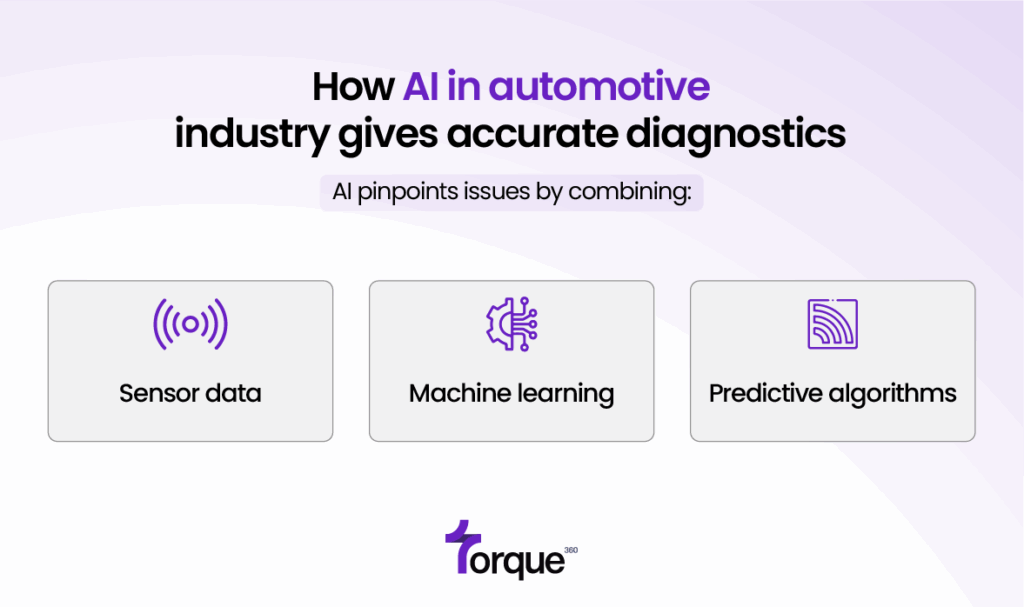
Here’s how AI is changing diagnostics in real-world shops:
Automotive diagnostics artificial intelligence tools
AI-powered diagnostic platforms use machine learning algorithms. This analyzes vehicle sensor data in real-time. These tools can detect anomalies, flag potential issues, and recommend solutions. Unlike traditional methods, AI keeps learning from new data. This improves its predictions over time.
AI-powered platforms can analyze data and predict maintenance needs. Though many shops are still preparing to adopt these technologies. Meanwhile, Torque360 helps manage repair records, parts, and scheduling. This helps shops to get ready to integrate advanced solutions in the future.
Real-time data analysis & sensor integration
Connected vehicles generate vast amounts of data. This data comes from engine sensors, brakes, transmission systems, and more. AI auto repair tools collect and interpret this information in real time.
The outcomes reduce unexpected failures and speed up the identification of root causes. They also provide intelligent insights into brake and suspension systems. This helps prevent repeat visits and ensures repairs are more reliable and thorough.
Top 3 AI Solutions for Automotive Shops
Shops need tools that synchronize with their workflow. This results in improved accuracy and provides actionable insights. This section highlights the AI tools making a difference in auto repair today.
1. Auto Repair Shop Software with AI
Modern repair shops are adopting AI auto repair software. It helps them automate scheduling, track diagnostics, and predict parts needs. These platforms turn raw vehicle data into actionable insights. This allows technicians to focus on repairs.
2. Predictive maintenance platforms
Predictive maintenance tools keep tracking vehicle health. It alerts shops to potential issues before they escalate. This approach minimizes downtime, lowers repair costs, and builds trust with customers.
3. Visual inspections & smart diagnostics
Computer vision tools can scan vehicles for scratches, dents, leaks, and alignment issues. AI compares the findings with historical data. It suggests precise repair actions, ensuring accurate and faster outcomes.
The Future of AI in Automotive Industry & Repair Shops
The evolution of AI solutions for automotive industry is accelerating. The repair shops that adapt now will be ahead of their competitors. Emerging technologies and automotive trends are shaping diagnostics, maintenance, and customer experiences. This creates new opportunities for efficiency and revenue.
Top trends shaping 2025 & beyond
- Integration of generative AI for real-time problem-solving and repair guidance
- Advanced driver monitoring systems feed data to shops for preventive service
- Expanded use of digital twins to simulate repairs and test solutions
Future of automotive repair industry & AI adoption
- AI as a core tool for predictive maintenance
- Early adopters are gaining efficiency, cost savings, and customer satisfaction
- Shops preparing for broader AI integration and competitive advantage
How shops can prepare for evolving AI tools
- Train technicians on AI-driven automotive diagnostics artificial intelligence
- Upgrade auto repair shop software with AI integration
- Establish data collection practices for vehicle health and repair history
Data-Backed Results from AI in Automotive
Tracking performance helps show how artificial intelligence benefits the automotive industry. Shops can measure improvements in repair accuracy with AI adoption.
Reduced downtime & repair costs
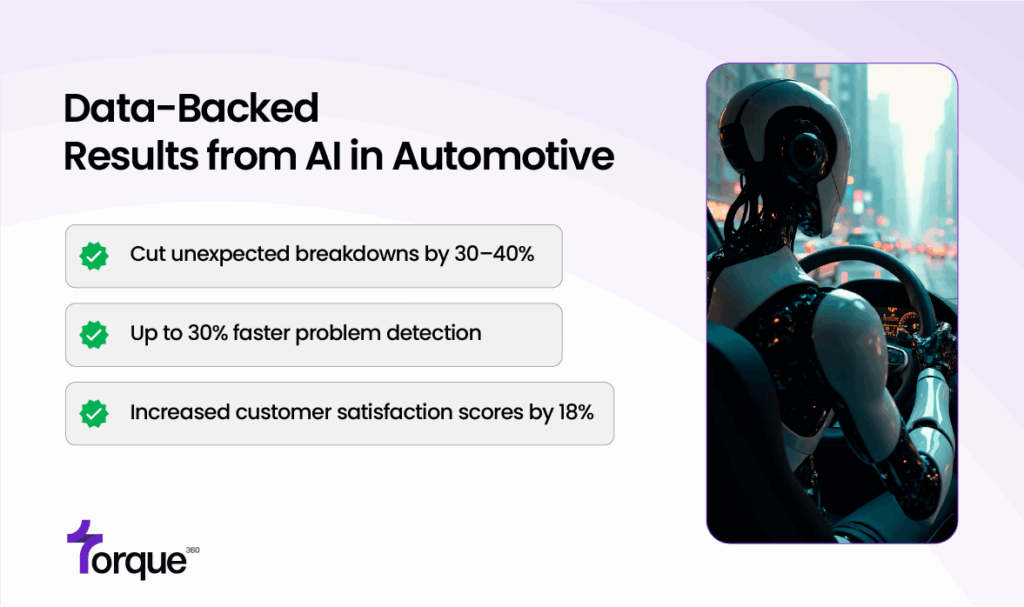
AI predictive maintenance can cut unexpected breakdowns by 30–40%. This reduces the hours vehicles spend in the shop. By lowering the frequency of part replacement errors, shops save both time and money. While freeing technicians allows them to focus on more complex repairs. Over time, these efficiencies combine to improve shop productivity and profitability.
Increased diagnostic accuracy
Shops using automotive diagnostics artificial intelligence report up to 30% faster problem detection. Early identification of potential failures reduces repeat visits and recurring repairs. This improves workflow efficiency. The accelerated and accurate diagnostic process also builds technician confidence. It reduces costly trial-and-error approaches.
Improved customer trust & satisfaction
AI solutions for customer service show increased customer satisfaction scores by 18%. The clients receive clearer, more reliable repair updates. Predictive maintenance reduces unexpected breakdowns. It fosters loyalty through fewer surprises and more predictable vehicle performance. By delivering accurate and timely service, shops strengthen trust and long-term customer relationships.
5 Challenges & Considerations for Implementing AI Auto Repair Solutions
Artificial intelligence in automotive industry brings immense value. It also comes with challenges. Understanding these early can help shops use AI and avoid common pitfalls.
1. Data management & integration
AI relies on structured, comprehensive vehicle and repair data. Shops with fragmented records may struggle to feed accurate information into AI tools. Repair history tracking, parts inventory, and DVI features centralize data. It’s easier to feed reliable information into predictive and diagnostic AI systems.
2. Reliability & technician training
AI outputs are only valuable if technicians can interpret and confirm them. Standardized checklists, workflow templates, and photo/video documentation help technicians cross-check AI recommendations. It improves reliability and ensures decisions rely on verifiable evidence.
3. Privacy & regulatory compliance
Connected vehicles collect sensitive customer and vehicle data, requiring secure handling. Secure cloud storage and audit trails help shops follow privacy regulations.
4. Workflow integration
AI recommendations must fit into existing repair workflows. Task management and scheduling allow shops to align AI insights with daily operations. This ensures technicians can act immediately without disrupting service.
5. Cost vs. ROI assessment
Implementing AI involves investment in tools, training, and process changes. Centralized reporting and analytics help shop owners track efficiency gains and cost savings. It supports informed decisions about AI adoption.
Next 3 Steps for AI Auto Repair Businesses
To get the full benefits of AI, shops need a clear adoption plan. The following are the 3 steps that will help you use AI in your repair business.
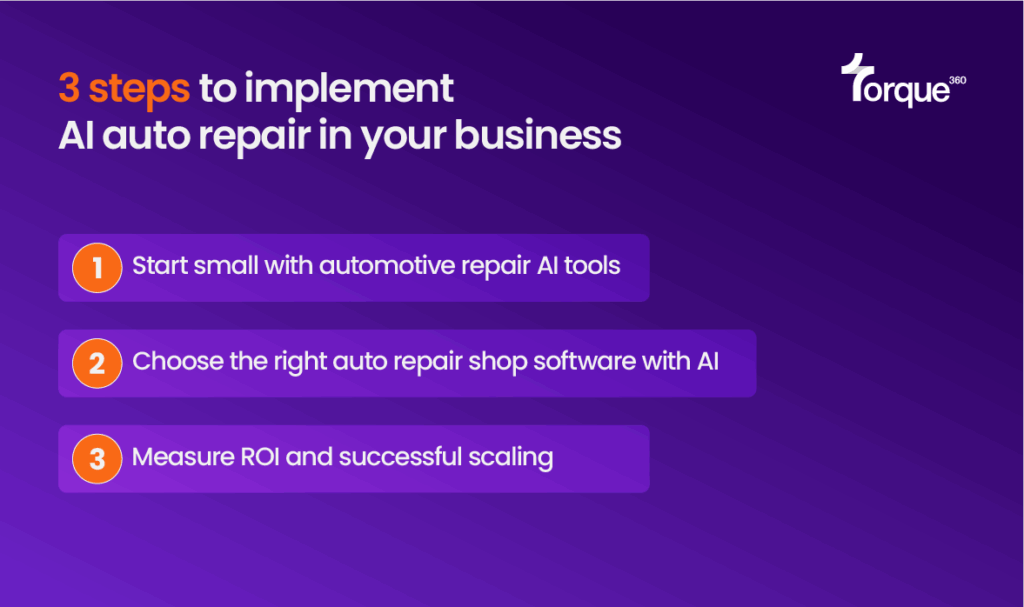
Step 1: How to start small with automotive repair AI tools
Begin by implementing a single predictive maintenance module or piloting visual inspection. Do this on a limited number of vehicle types. Focus on specific problem areas first. These could be engine diagnostics or brake system inspections. This minimizes disruption and measures clear improvements.
Track technician adoption, the accuracy of AI recommendations, and any necessary workflow adjustments. Refine your approach based on real-world results. Only then expand AI across other services.
Step 2: Choosing the right auto repair shop software with AI
Look for software that integrates diagnostics, predictive analytics, and repair management. Consider features such as centralized repair histories, parts inventory management, and workflow automation.
Ensure the system can integrate with your current tools. Also, it should support data-driven decision-making. This way, AI insights integrate into your shop’s daily operations.
Step 3: Measuring ROI & successful scaling
Track metrics like repair cost savings, improvements in diagnostic accuracy, and customer satisfaction. Use reporting features to quantify efficiency gains, parts use, and recurring repair reduction.
Early wins should guide your broader AI adoption strategy. It should show tangible benefits to your team and management. Scale AI tools step by step to cover more vehicle types and workflows. This ensures every expansion relies on data-driven results.
Making Your Shop Smarter with AI-Driven Decisions
Artificial intelligence in automotive industry is transforming how repair shops operate. It is changing the way they approach predictive maintenance and diagnostics. These AI tools may not be part of your workflow today. Yet tracking parts and managing workflows sets your shop up for the future. By building this foundation now, you can adopt AI technologies. This will help your shop stay ahead in accuracy, efficiency, and customer trust.
Frequently Asked Questions
What exactly is predictive maintenance in the future auto industry?
Predictive maintenance uses vehicle data and repair histories. It helps to expect when parts may fail. This helps shops address issues before they become costly. Shops can start preparing today by keeping organized workflows with Torque360. It will help them set up to adopt predictive insights in the future of AI in automotive industry.
How does AI improve vehicle diagnostics?
AI improves diagnostics by analyzing vehicle sensor data. It identifies patterns and suggests potential issues faster than traditional manual inspections. Automotive diagnostics artificial intelligence helps shops maintain structured repair histories. It also helps to track service trends. This provides a strong foundation for integrating predictive tools later.
What are the common challenges to adopting AI in auto repair shops?
Implementing AI involves handling large amounts of vehicle data. This ensures technicians can interpret recommendations and maintain privacy compliance. Torque360 helps shops manage repair records, parts, and service schedules. It gives them organized data needed for future auto industry AI adoption.
How much can AI solutions for automotive reduce maintenance costs?
AI-powered predictive maintenance can lower costs by reducing unexpected breakdowns. This improves diagnostic accuracy and avoids unnecessary part replacements. Even before adopting AI, shops can track repairs and trends with Torque360. This helps in gaining operational insights that improve efficiency.
How can repair shops prepare now for automotive repair AI tools in the future?
Shops can prepare by keeping repair data organized, standardizing workflows, and training technicians. Using Torque360 ensures shops are ready to integrate AI technologies.